Photo: Fleming, James Sturk / Wikimedia Commons / Public Domain — Source
Bannockburn House: From Drummondhall to Community Archaeology
A Jacobite mansion, a hidden mine shaft and a musket ball — how SFAS volunteers are uncovering centuries of history in the grounds of one of Stirling's most remarkable buildings.
Introduction
On the southern outskirts of Stirling, set within 25 acres of gardens, woodland and fields, stands one of central Scotland’s most historically significant — and until recently most neglected — country houses. Bannockburn House (Category A listed, Canmore 74600) was built around 1675 by the lawyer Hugh Paterson, but its story reaches back far further: to medieval coal workings, to the lands granted by Mary Queen of Scots, and to a night in January 1746 when an assassin’s bullet narrowly missed the sleeping Bonnie Prince Charlie.
Since 2018 the Stirling Field and Archaeological Society has been conducting community archaeology at Bannockburn House in partnership with the Bannockburn House Trust. Season by season, volunteers have peeled back layers of the estate’s past — from Victorian garden features to a vaulted mine shaft that may date to the fifteenth century.
This article traces the history of the house and its grounds, surveys the archaeological discoveries made so far, and explains why Bannockburn House matters for our understanding of Stirling’s heritage.
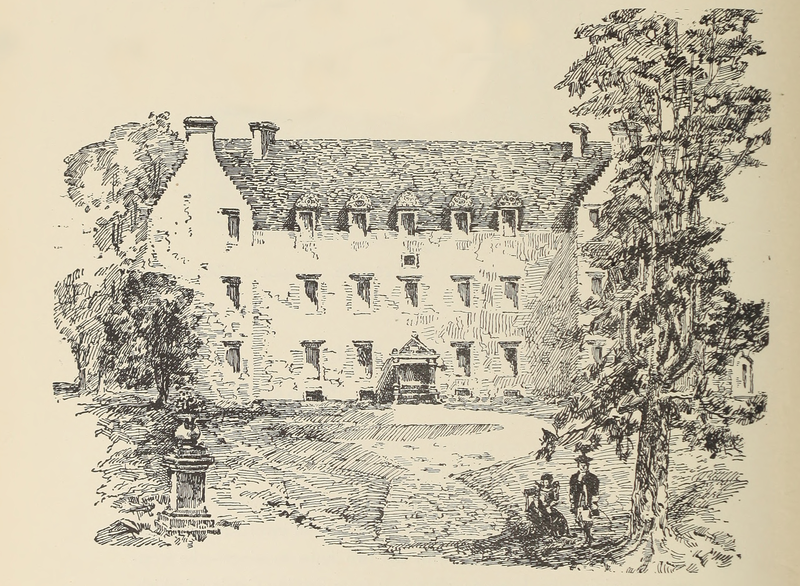
Photo: Fleming, James Sturk / Wikimedia Commons / Public Domain — Source
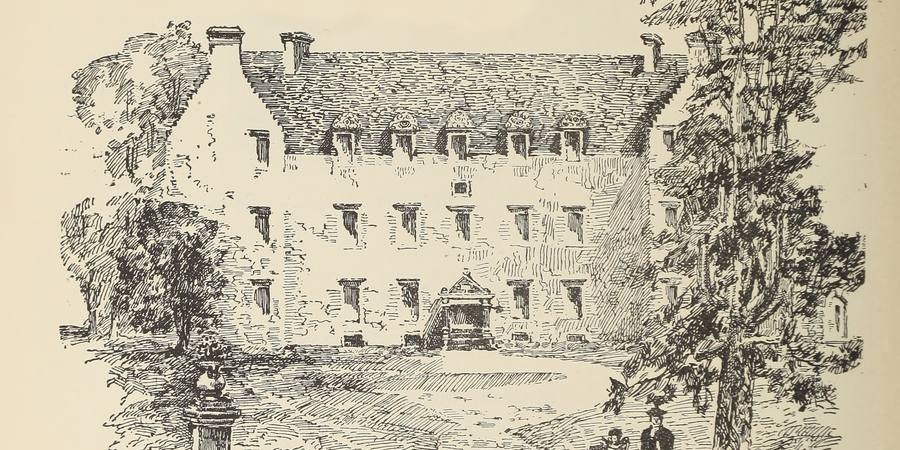
Historic illustration of Bannockburn House, from Ancient Castles and Mansions of Scotland by James Sturk Fleming, 1902. View on Wikimedia Commons · Public Domain

The House and Its Owners
Drummondhall and the Paterson Era
The lands of Bannockburn were granted to Robert Drummond of Carnock by Mary Queen of Scots in 1562, with a barony charter following in 1567. The estate included a building called Drummondhall (or Drummond’s Hall), and a tower marked “Bannokburne” appears on Timothy Pont’s late sixteenth-century maps (c.1583–1596) — likely the castle that was later incorporated into the present house.
The Rollo family acquired the lands and Drummondhall in 1636, and Sir Andrew Rollo received a baronetcy from Charles II in 1651. By about 1672 the estate had passed to Hugh Paterson, a lawyer who served as factor to the Countess of Moray and operated coal mines on the property. It was Paterson who built the house we see today, around 1675–1680.
Historic Environment Scotland describes the result as “an outstanding example of late seventeenth-century country house design in central Scotland.” The house is an H-plan of three storeys with basement, crowned by crowstepped gables and pedimented dormers with carved strapwork. Inside, two richly ornamental plaster ceilings in the style of Charles II survive — comparable in quality to those at the Palace of Holyroodhouse.
The Jacobites at Bannockburn
The house’s most dramatic chapter came in January 1746. During the siege of Stirling Castle and the approach to the Battle of Falkirk Muir, Charles Edward Stuart — Bonnie Prince Charlie — used Bannockburn House as his headquarters. It was here that Sir Hugh Paterson’s niece, Clementina Walkinshaw, nursed the Prince when he fell ill. She would later join him in exile in Ghent and bear his only child, Charlotte, Duchess of Albany, in 1753.
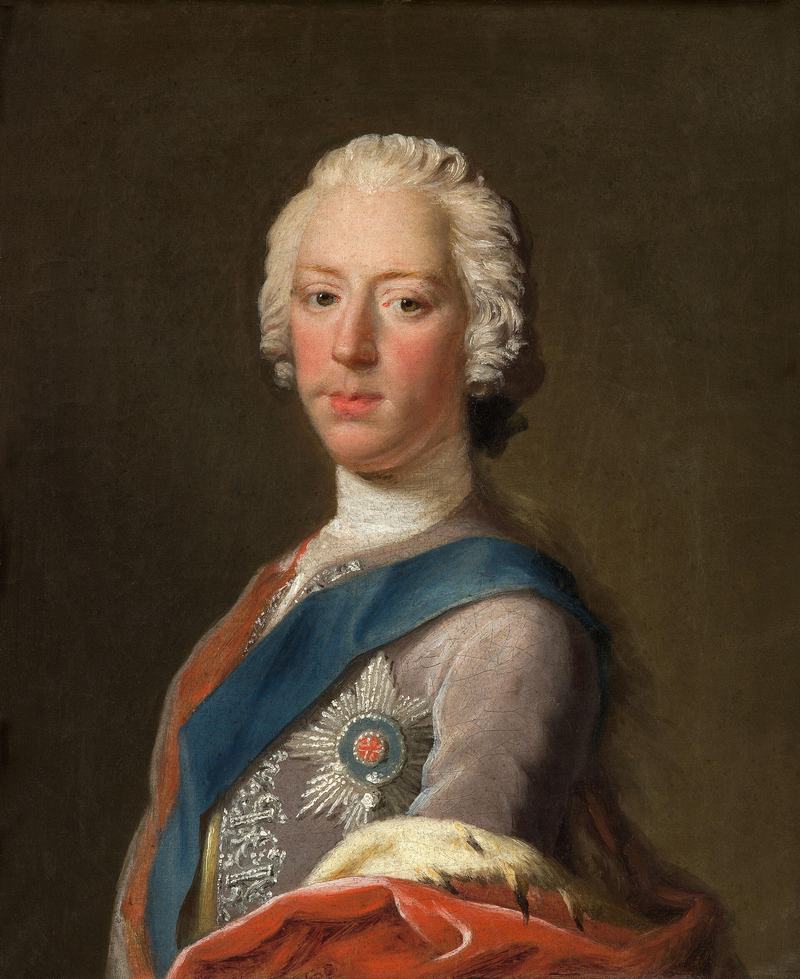
Photo: Allan Ramsay / Wikimedia Commons / Public Domain — Source
Portrait of Bonnie Prince Charlie by Allan Ramsay, painted at the height of the 1745 Rising. Scottish National Portrait Gallery. View on Wikimedia Commons · Public Domain

House oral tradition records that during the Prince’s stay, an assassin fired a musket through his bedroom window while he slept. The shot lodged in the wall at the head of the bed, narrowly missing him. For nearly three centuries this story was unverified — until April 2024, when volunteers uncovered the musket ball hole hidden behind a secret panel (see Discoveries, below).
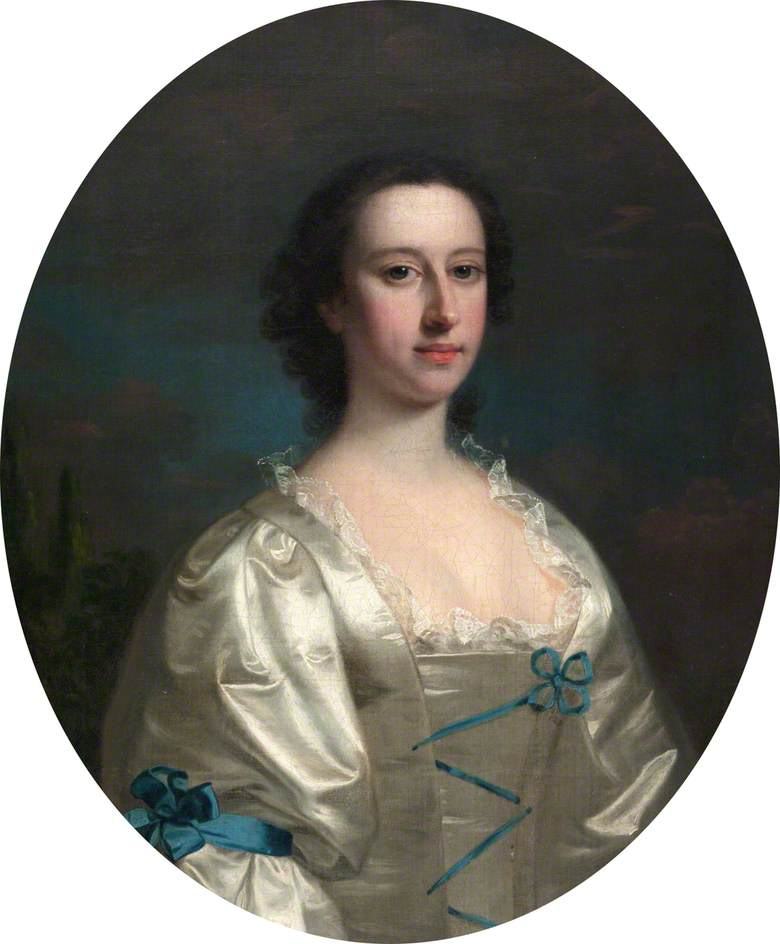
Photo: Allan Ramsay / Wikimedia Commons / Public Domain — Source
Portrait of Clementina Walkinshaw by Allan Ramsay. West Highland Museum. View on Wikimedia Commons · Public Domain
_-_Clementina_Walkinshaw_(1720%E2%80%931802)_-_2003.2_-_West_Highland_Museum.jpg)
Later Owners and Decline
Ownership timeline:
- 1787 — William Ramsey of Barnton purchased the estate
- 1808 — William Stirling added library bay windows
- 1883 — Lt Col Alexander Wilson, textile manufacturer (tartan); major rear extension by Frederick Waller & Sons
- 1910 — Sheriff James Mitchell, Sheriff Substitute of Stirling
- 1962 — A.E. Pickard, multi-property millionaire
- 2017 — Bannockburn House Trust — community buyout with public funding
After decades of declining use, Bannockburn House was placed on the Buildings at Risk Register in 1990. It remained inaccessible for over thirty years until the community buyout of 2017, when the Bannockburn House Trust acquired the property with a mixture of public grants and community fundraising. Today the Trust manages the house and grounds, which include a walled garden, orchard, rockery, polytunnels and a kitchen garden that supplies fruit and vegetables to two local food banks.
Archaeological Significance
Bannockburn House sits at the heart of a landscape saturated with history. The Battle of Bannockburn (1314) was fought across the fields to the north; the Randolphfield Standing Stones, once attributed to the battle, have been shown by excavation to be Bronze Age (3,000–4,000 years old); and the Lower Greenyards promontory fort above the Bannock Burn testifies to Iron Age settlement millennia before Robert the Bruce.
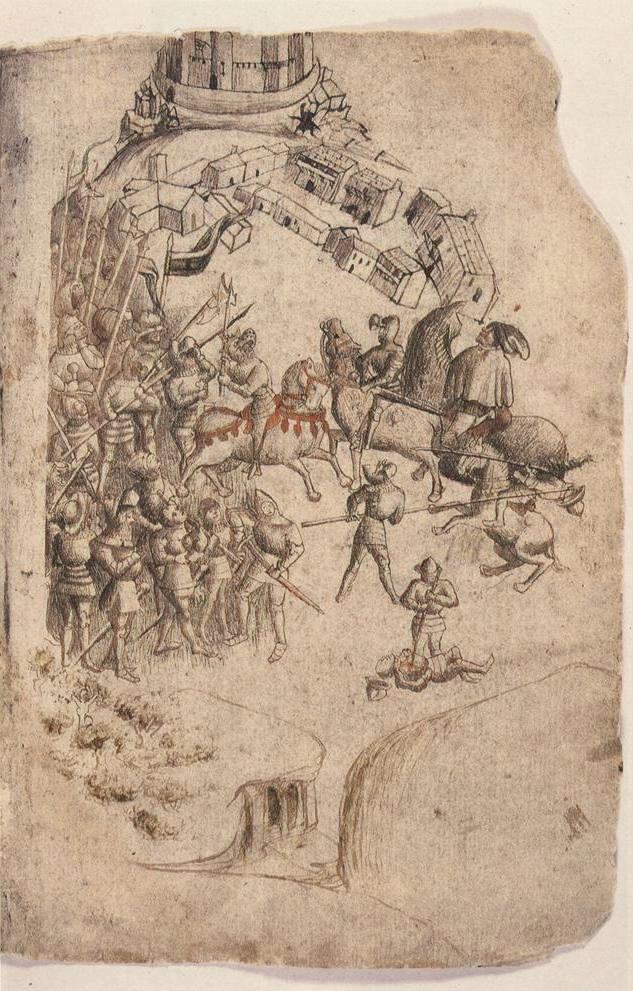
Photo: Unknown authorUnknown author / Wikimedia Commons / Public Domain — Source
The Battle of Bannockburn, from a 1440s manuscript. View on Wikimedia Commons · Public Domain

The house itself, with its seventeenth-century architecture, Jacobite connections and earlier medieval remains, offers a rare opportunity to study a single estate across at least six centuries of continuous use — from medieval coal extraction to Victorian domestic life.
SFAS Excavations: Season by Season
2018 — Metal Detecting and Test Pitting
The first season aimed to test whether traces of the Jacobite army camp survived in the grounds. Six 1m × 1m test pits were excavated across the estate. Three of these revealed two pits and four postholes — possible evidence of temporary shelter structures. Metal detecting recovered 74 iron artefacts (most unidentifiable due to poor preservation), seven copper-alloy coins and buttons, and — most significantly — a lead pistol bullet consistent with mid-eighteenth-century military use.
2019 — Geophysical Survey
A combined electrical resistance and gradiometric survey was conducted in the field east of the walled garden, ahead of planned polytunnels and orchards. The resistance survey revealed widespread low-resistance responses in the southern part of the field, likely corresponding to a pond or open water channel leading from the rockery. More intriguingly, it identified a low circular earthwork with a strong magnetic response and a low-resistance anomaly at its centre — a feature that would prove to be the entrance to something entirely unexpected.
Separately, Addyman Archaeology opened three evaluation trenches as part of a wider Conservation Plan. These produced eighteenth-century trackways and sixteenth- to seventeenth-century pottery fragments.
2021 — The Midden
Six trenches were excavated across a nineteenth-century midden first exposed during 2019 water supply works. The deposits — reaching a maximum depth of one metre — contained decorative pottery, bottle glass, metal objects dating from 1802 to 1910, large quantities of coal ash from house hearths, building rubble, slate shingles and deposits of tarry material.
The midden had a defined southern boundary marked by a vertical semicircular rock exposure — possibly the remains of an earlier coal working or exploratory pit that was later repurposed for household waste. The assemblage provides a vivid snapshot of domestic life during the Wilson and Mitchell ownership periods.
2022 — The Vault
SFAS and Bannockburn House volunteers returned to the circular feature identified in the 2019 geophysical survey. Excavation revealed a vaulted roof constructed from roughly hewn rectangular sandstone blocks, mortared and pinned with slate. Initial interpretation suggested a cellar or icehouse.
2023 — A Mine Shaft Confirmed
A week-long volunteer dig in June 2023 — involving SFAS members, Bannockburn House volunteers and the Stirlingshire Young Archaeologists’ Club — cleared the area around the vault. The team uncovered a roughly circular surrounding wall and a lintel to a northern doorway. Workers reported feeling a cold draught when the entrance passage was opened, initially reinforcing the icehouse hypothesis.
Later that year the doorway and entrance passageway were fully exposed. The Bridge of Allan Well House caving team lowered a camera into the structure and the mystery was solved: it was a coal mine shaft, complete with sockets and ledges cut into the sandstone to support ladders and extraction platforms.
Approximately 20 sherds of fourteenth- to fifteenth-century pottery found near the entrance suggest the mine predates the present house by at least two centuries — aligning with the documented coal-working activities on the estate and Hugh Paterson’s known mining operations.
2024 — The Musket Ball
In April 2024 the most dramatic discovery yet was made inside the house itself. Volunteers found a musket ball hole hidden behind a secret panel in the bedroom wall where Prince Charles had slept in January 1746. The discovery was authenticated by Professor Murray Pittock of the University of Glasgow and Dr Murray Cook.
Pittock described it as “critically important not only for our understanding of the Rising but also for the role the attack may have played” in developing the Prince’s relationship with Clementina Walkinshaw, who nursed him during his subsequent illness.
2025 — Clementina's Garden and Young Carers
In July 2025 SFAS partnered with Stirling Young Carers for “Attainment through Archaeology” — a ten-workshop programme in which 18 young people investigated Clementina’s Garden, a Victorian water garden and rockery that first appears on a map of 1930.
Finds included:
- Blue-and-white transfer-printed ceramics (1800s)
- A “Sankey” stamped terracotta pot sherd (Richard Sankey & Son, Nottingham, 1895–1939)
- Clay tobacco pipe stem and bowl (1800s)
- A ceramic saltglaze marble or stoneware ball (possibly 1600s–1700s)
- Glass sherds including a Jeyes Fluid bottle (late 1800s–early 1900s)
- Animal bone (rabbit or hare)
- A sherd of medieval green-glazed ware (pre-1600)
Participants were taught trowel technique, context recording, photogrammetry for 3D site documentation, and artefact measurement and photography. All earned Bronze Heritage Hero Awards.
The Wider Bannockburn Landscape
The Battle of Bannockburn, 1314
The fields north of Bannockburn House were the setting for Scotland’s most celebrated military victory. On 23–24 June 1314, Robert the Bruce defeated the army of Edward II in a battle that secured Scottish independence for a generation. The exact site remains debated, but recent research by GUARD Archaeology (2011–2014) using LiDAR, aerial photography and excavation has narrowed it to two adjacent areas: the Carse of Balquhiderock and the Dryfield of Balquhiderock.
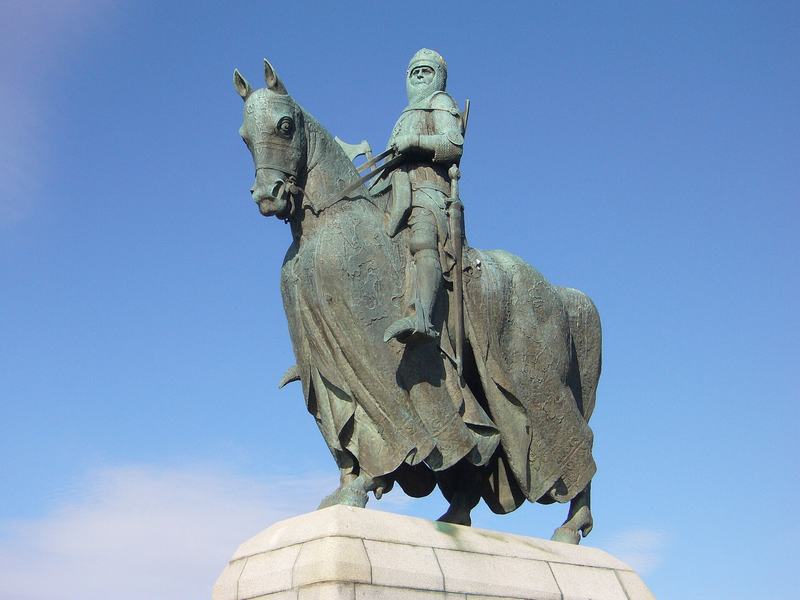
Photo: Kim Traynor / Wikimedia Commons / CC BY-SA 3.0 — Source
Robert the Bruce equestrian statue by Pilkington Jackson (1964) at Bannockburn. View on Wikimedia Commons · Photo: Kim Traynor / CC BY-SA 3.0

The NTS Bannockburn Heritage Centre stands near the traditional site of the Borestone where Bruce planted his standard. The heroic equestrian bronze by Charles d’Orville Pilkington Jackson, erected in 1964 for the 650th anniversary, faces south towards Edward II’s line of advance.
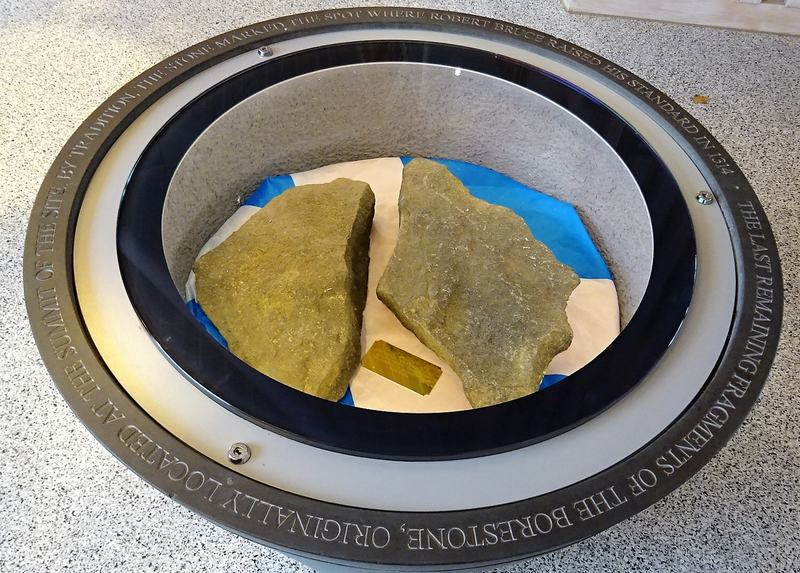
Photo: Rosser1954 / Wikimedia Commons / CC BY-SA 4.0 — Source
The Borestone at Bannockburn Battlefield. View on Wikimedia Commons · Photo: Rosser1954 / CC BY-SA 4.0

The Monymusk Reliquary
One of Scotland’s most sacred objects has a direct connection to Bannockburn. The Monymusk Reliquary (Brecbennach), a house-shaped shrine of c.750 AD now in the National Museum of Scotland, is traditionally identified as the reliquary of St Columba that was carried before the Scottish army at the Battle of Bannockburn. The Abbot of Arbroath was granted lands specifically for the duty of bearing it into battle.
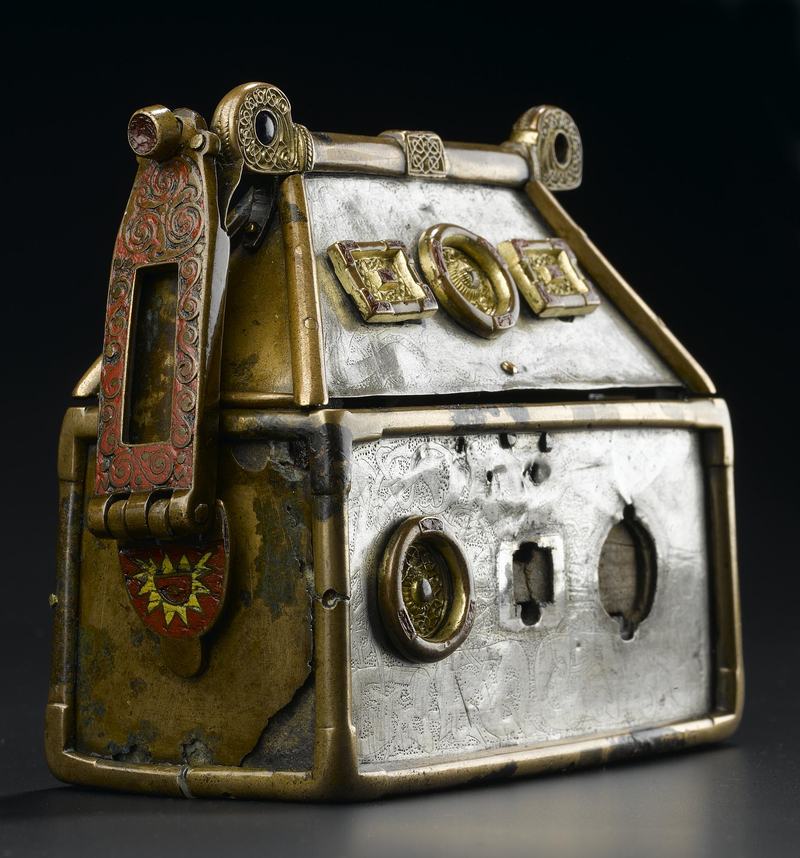
Photo: National Museums Scotland / Wikimedia Commons / CC BY-SA 4.0 — Source
The Monymusk Reliquary, c.750 AD. National Museum of Scotland. View on Wikimedia Commons · Photo: National Museums Scotland / CC BY-SA 4.0

Other Bannockburn Sites
- Randolphfield Standing Stones — Bronze Age (c.2000–1500 BC). Pair of standing stones, excavation proved prehistoric origin; connected to Viewforth cist cemetery
- Lower Greenyards Promontory Fort — Iron Age. Fort and palisaded homestead above the Bannock Burn; excavated 1982–85
- Bannockburn Heritage Centre (NTS) — Medieval commemoration. Visitor centre, Borestone site, Pilkington Jackson statue (1964)
- Skeoch Mill — Post-Medieval. Historic mill site on the Bannock Burn
- Bannockburn House Dovecot — 1698. Category B listed, 18-foot-square rubble masonry, dated lintel
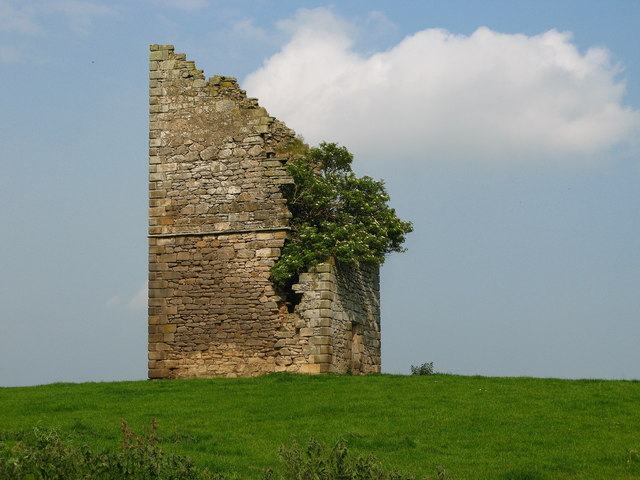
Photo: Lisa Jarvis / Wikimedia Commons / CC BY-SA 2.0 — Source
Bannockburn House Doocot (1698). View on Wikimedia Commons · Photo: Lisa Jarvis / CC BY-SA 2.0

Timeline: Bannockburn House Through the Centuries
- c.1350–1400 — Earliest pottery found near the mine shaft — coal extraction may already be under way
- 1562 — Mary Queen of Scots grants lands of Bannockburn to Robert Drummond of Carnock
- 1567 — Barony charter for Bannockburn
- c.1583–1596 — “Bannokburne” tower appears on Timothy Pont’s maps
- 1636 — Rollo family acquires Drummondhall
- 1651 — Sir Andrew Rollo receives baronetcy from Charles II
- c.1672 — Hugh Paterson acquires the estate
- c.1675–1680 — Present house built — H-plan, three storeys, ornamental plaster ceilings
- 1698 — Dovecot erected (dated lintel)
- January 1746 — Bonnie Prince Charlie uses the house as his headquarters; assassination attempt; Clementina Walkinshaw nurses the Prince
- 1753 — Clementina bears Charlotte, Duchess of Albany, in Ghent
- 1787 — William Ramsey of Barnton purchases the estate
- 1808 — William Stirling adds library bay windows
- 1883 — Lt Col Alexander Wilson acquires house; major rear extension
- 1895–1939 — Sankey plant pots in use at the gardens (dated by 2025 excavation finds)
- 1910 — Sheriff James Mitchell becomes owner
- 1962 — A.E. Pickard acquires the property
- 1990 — House placed on Buildings at Risk Register
- 2017 — Bannockburn House Trust completes community buyout
- 2018 — SFAS begins community archaeology — test pits find Jacobite-era postholes, coins and pistol bullet
- 2019 — Geophysical survey identifies circular anomaly; Addyman Archaeology evaluation
- 2021 — SFAS excavates 19th-century midden (1802–1910 deposits)
- 2022 — SFAS uncovers vaulted structure (initially thought to be icehouse)
- 2023 — Mine shaft confirmed — camera reveals coal extraction shaft with sandstone ladder sockets; 14th–15th century pottery
- 2024 — Musket ball hole discovered behind secret panel in Prince Charlie’s bedroom — authenticated by Prof. Murray Pittock
- 2025 — SFAS + Stirling Young Carers excavate Clementina’s Garden; medieval green-glazed ware found
Why It Matters
Bannockburn House is a rare thing: a site where community archaeology, heritage conservation and public engagement come together on a single estate. The SFAS programme has:
- Confirmed the Jacobite camp through physical evidence (postholes, coins, pistol bullet)
- Discovered a pre-house mine shaft that rewrites the estate’s industrial history
- Authenticated a three-century-old oral tradition with the musket ball discovery
- Engaged young people in hands-on fieldwork through the Young Carers partnership
- Built a lecture series (available on YouTube) that serves as an introduction to Stirling’s wider archaeological heritage
The work is ongoing. Each season reveals new features and new questions. With its seventeenth-century architecture, Jacobite drama, medieval mine workings and Victorian gardens, Bannockburn House offers volunteers — and the wider public — a tangible connection to Scotland’s past.
If you would like to get involved in future excavation seasons, visit the SFAS events page or contact us.
Getting There
Bannockburn House, Bannockburn, Stirling FK7 8EY. The house is approximately 2 miles south of Stirling city centre, off the A872.
- View on the SFAS Interactive Map
- Bannockburn House Trust website
- Canmore record (74600)
- HES Listed Building entry (LB15277)
Sources and Further Reading
- Bannockburn House Trust, Our History
- Bannockburn House Trust, Important Jacobite Historical Discovery Made at Bannockburn House (2024)
- Dig It!, How Volunteers Uncovered an Early Mine Shaft at a Jacobite Mansion
- Archaeology Scotland, Attainment through Archaeology with Stirling Young Carers at Bannockburn House (2025)
- Historic Environment Scotland, Bannockburn House Through Time (2018)
- University of Glasgow, Jacobite Discovery at Bannockburn House (2024)
- Canmore, Bannockburn House (74600)
- Canmore, Bannockburn House Old Dovecot (46867)
- Canmore, Battle of Bannockburn (47243)
- Stirling City Heritage Trust, Bannockburn House
- GUARD Archaeology, Finding the Battle of Bannockburn
- Rideout, J.S. et al., ‘Excavation of a Promontory Fort and Palisaded Homestead at Lower Greenyards, Bannockburn’, Proceedings of the Society of Antiquaries of Scotland, Vol. 126 (1997), pp. 199–269
- Stirling Archaeology Substack, Bannockburn House Lecture Series
The Stirling Field and Archaeological Society has been exploring Scotland’s heritage since 1878. Join the Society to support our work, or make a donation to help us continue community archaeology projects like Bannockburn House.